Kings of B’more by R. Eric Thomas 

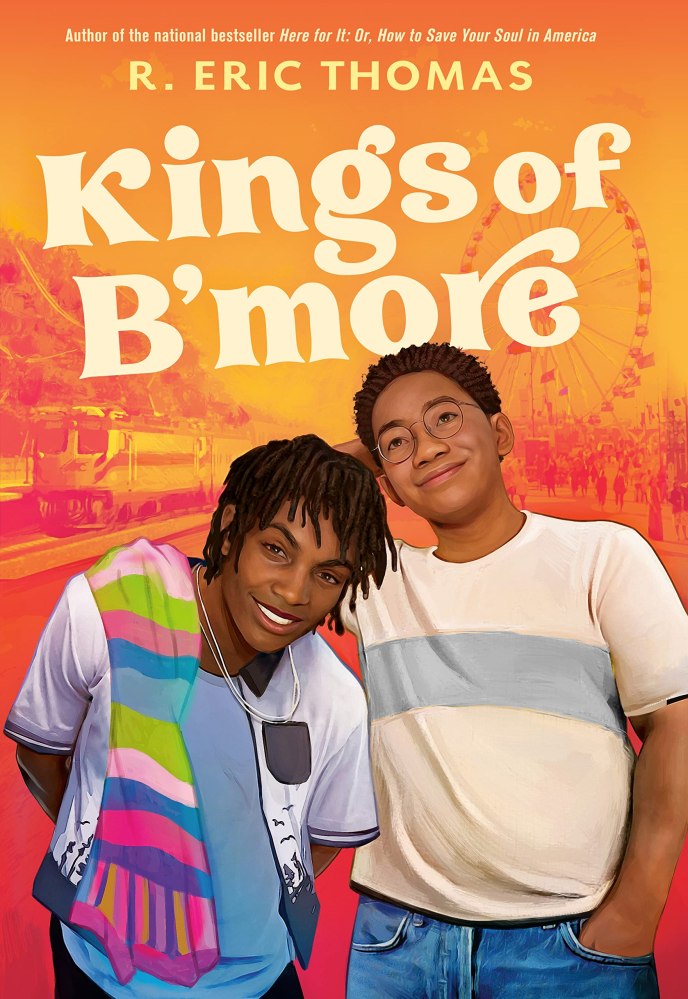
Against a summery orange background, that shows a ferris wheel and light-rail train, two young Black boys smile

by Eliana H.

R. Eric Thomas is a Baltimore-based television writer, playwright, and the bestselling author of Here for It: Or, How to Save Your Soul in America and Reclaiming Her Time: The Power of Maxine Waters. He is also the (temporary) Prudie, answering questions for the Dear Prudence column in Slate magazine through mid-summer. He is visiting in-person at the Elkridge Branch + DIY Center on Wednesday, June 15 at 6:30 pm. He will be discussing his debut young adult novel, Kings of B’more. I had the wonderful opportunity to read an advance copy, and I am so excited to share it with you.

Have you ever seen Ferris Bueller’s Day Off? In the popular movie from the 1980s, the title character, a high school student, skips school to take his best friend and girlfriend on a whirlwind adventure all over Chicago. When the main character of Kings of B’more, Harrison, learns that his best friend, Linus, will be moving to South Carolina in just a few days, he is inspired by the movie – which his dad has just made him watch – to plan an adventure all around Baltimore for the two of them. Despite his grand ideas and the help Harrison enlists, things (of course) don’t quite go as planned. The boys manage to have an epic day nonetheless.

Throughout the book, I was struck by the beauty of the friendship between Harrison and Linus. Author R. Eric Thomas captures a fresh, unique voice and perspective for each of them while highlighting the ways in which they complement one another. They can have entire conversations with their eyes, they see and value the truth of each other, and they show their affection in ways large and small. As two Black queer young men, they certainly face some challenges. But Harrison and Linus support one another as each discovers his own way to take on the world. I thoroughly enjoyed the language that Thomas uses, with vividly descriptive passages that bring the surroundings to life. Baltimore really becomes another character in this story, not just the setting. 

With ups and downs and so many adventures, Thomas has packed an entire coming-of-age tale into a story taking place over a single weekend. The growth each character experiences occurs in a way that is completely natural in terms of what they are going through. Harrison and Linus feel authentic and well-developed, and I was so glad to get to know them as I read. Despite a very satisfying ending, I would love to know what happens next. And I am definitely planning my next foray into Baltimore as soon as possible! 

I hope you will join us at the upcoming author event to hear more from R. Eric Thomas, ask questions, and consider purchasing a book for signing (if you want).

Eliana is a Children’s Research Specialist and Instructor at HCLS Elkridge Branch. She loves reading, even if she’s slow at it, and especially enjoys helping people find books that make them light up. She also loves being outside and spending time with friends and family (when it’s safe).

Under The Whispering Door by TJ Klune

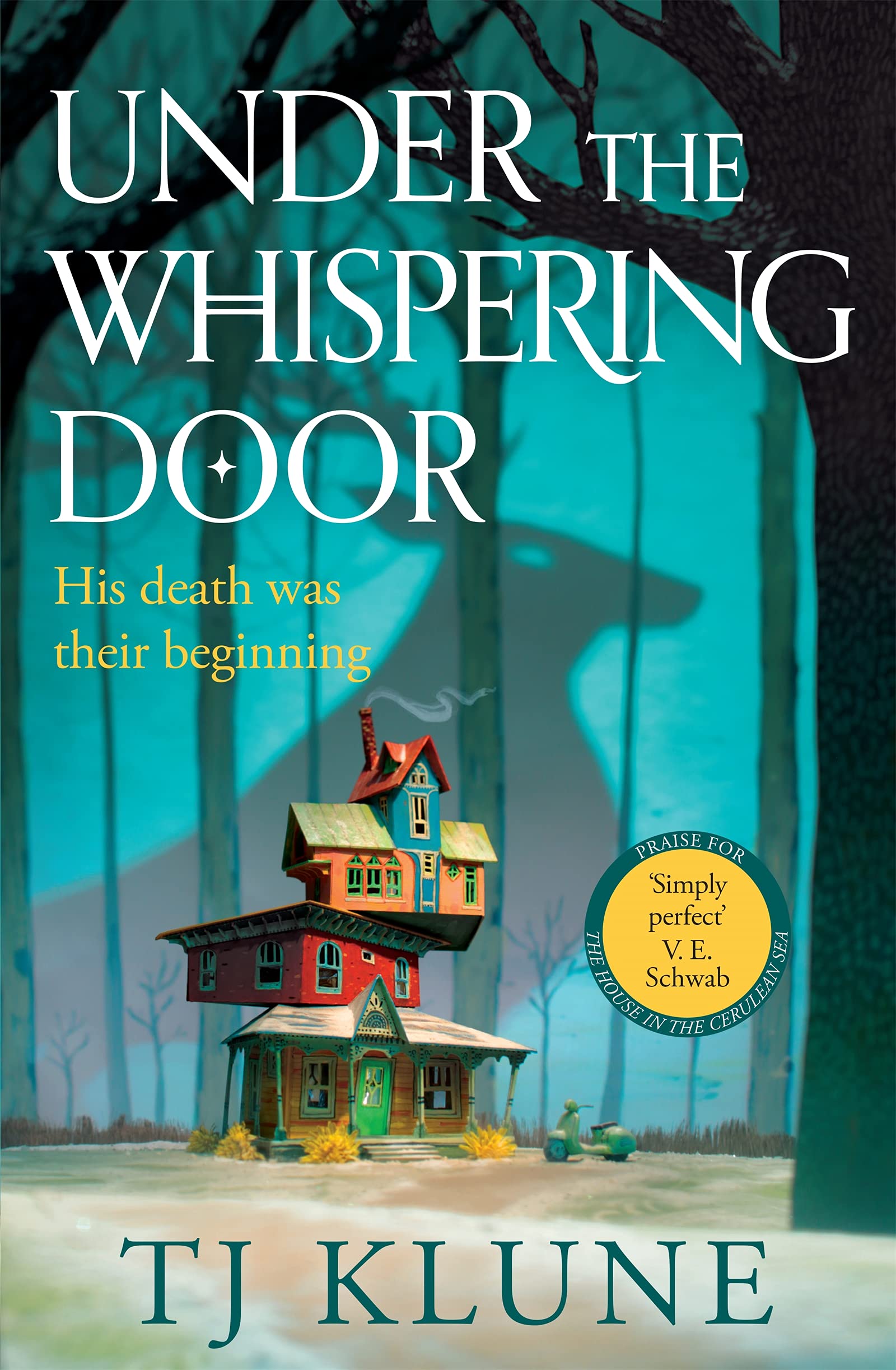
The illustrated cover shoes a topsy-turvel house in the clearing of a large wood. The shadow of a large stag appears behind the house.

by Sahana C.

Loss is not an easy subject matter. The nuances of grief and grieving, mixed with the general sense of well-what-comes-next is hard to grapple with. And yet somehow, in Under the Whispering Door, TJ Klune has delivered another gentle reminder to readers that the best way to endure, survive, and eventually thrive through hardship is by finding your people, letting them help you and love you, and helping and loving them in return.  

An illustration shows a raggedy spit of land above a blue sea, with a red house with lots of windows at its very edge. Windswept trees and a blue and pink sunset sky frame the house.

Folks who know the author’s work after reading The House in the Cerulean Sea might be surprised, at first, by the level of angst present at the outset of this book. After all, if Cerulean Sea could tout the Antichrist as one of its main characters and still feel light, fluffy, and comforting, surely this novel about dead people can’t be that deep.  

Apparently, it can though.  

Most of that is due to the fact that Wallace Price, the main character, is simply obnoxious and unpleasant at the beginning. He is so unlikable in the very first chapter, so out of touch, that I wasn’t sure I wanted redemption for him. He got what he deserved, dying at the end of the first chapter. This is not a spoiler, the man is dead throughout the book. The main character is, in fact, a ghost-or-something the whole time. A fun time is had by all, except Wallace, when he dies.  

Seeing the other characters humor him and tease him was a relief because he was just so darn unpleasant that I didn’t much care how he’s feeling about being dead. Until, suddenly, I did. Without my knowledge or consent, I suddenly cared about Wallace, and that is precisely the magic that TJ Klune makes. He sneaks these strange characters on readers, makes it very clear that the characters are mostly a menace to society and not very good at being people, and then gently, steadily, these characters are shown how to be good people, how to care about others, how to crave belonging like they never have before.  

There is a tenderness with which Wallace is treated by Hugo, a man who is very important in Wallace’s undeath. Equally important are Mei, the Reaper who comes to collect Wallace’s soul-or-equivalent, Nelson, Hugo’s boisterous and larger than life grandfather, and Apollo, the dog.  

Difficult scenes force readers to confront loss in a very real way, and they are masterfully interspersed with incredible levity. Things like Wallace suddenly remembering he’s dead and sinking through the floor as the rest of the group does nothing to help but laugh are both incredibly funny and also the moments that Wallace is learning the most. The sad parts are to be expected, but as Wallace himself begins to use as a mantra: the real lesson is in unexpecting

This is a character driven novel, of course, because when considering something as deeply personal as loss, one must return to the people that are experiencing the emotion. The way that Klune uses all of the characters to fill in any gaps in Wallace’s story, but also allows them to have their own back stories, personalities, and flaws without detracting from Wallace’s growth, is a delicate balancing act that Klune has down to a science.  

Ryka Aoki, author of Light from Uncommon Stars , described the book beautifully, saying, “There is so much to enjoy in Under the Whispering Door, but what I cherish the most is its compassion for the little things―a touch, a glance, a precious piece of dialogue―healing me, telling me that for all the strangenesses I hold, I am valued, valid―and maybe even worthy of love.” 

This book is about healing and holding yourself accountable. It’s about always having more to learn, but having to be willing to learn it. It does not force, but gently asks a reader to consider, Am I happy? Am I doing what I want, surrounded by the people I love? What do I have to do to get there?  

And most of all, whatever you expect to happen here, wherever you think the story is going to go, unexpect it. Wallace was right. It’ll get you there faster.  

Under the Whispering Door is available in print, eBook, and eAudiobook.  

Sahana is an Instructor and Research Specialist at the Savage Branch. She enjoys adding books to her “want to read” list despite having a mountain of books waiting for her already.

Penric & Desdemona novellas

Painting of a fair blond man with a long braid and a white shirt in a narrow boat in a canal; the setting looks a lot like Venice.

by Kristen B.

One of the delights of reading fantasy stories is the wide range of “what ifs” that authors cook up for our enjoyment. What if a hobbit went on an adventure and discovered a long-lost ring of power? What if a pack of werewolves lived in the Pacific Northwest? What if demonic possession was not an entirely dangerous or horrible affliction? Hold onto that last thought…

Lois McMaster Bujold, a long-time favorite author, always inflicts situations on her characters that stretch them to their utmost and confound them utterly. In one of her created universes, folks worship a pantheon of Five Gods – Father and Mother, Son and Daughter, and Bastard. The Bastard is the god of all things out of season and out of “sorts,” if you will. Demons are creatures of chaos belonging to the Bastard, and they can only exist in the “real world” if they inhabit a creature, usually some sort of wild animal. As one host dies, the demon jumps to the next closest creature, always looking to increase complexity of animal – eventually, sometimes, making it to a human.

Meet Desdemona, one of the oldest and most powerful demons. When she becomes invested in Penric kin Jurald, rather unexpectedly for both of them, she has the better part of 200 years of experience and brings an absolute wealth of knowledge with her. When Desdemona’s previous “rider” dies of heart failure, a great partnership is born between the old lady demon and her handsome new host. While Penric operates as the protagonist throughout the stories, Desdemona is my favorite. She provides ongoing pithy commentary in the vein of an older sister/aunt about the younger Penric’s decisions and passions. Honestly, Bujold’s way with wry commentary on humanity’s frailty and foibles is what keeps me coming back to her books.

Bujold has written more than ten novellas detailing the pair’s various adventures. They do seem to attract trouble as they sort out younger demons, practice spy-craft, fight pirates, court a wife for Penric, and solve plagues. In all the stories, the balance between performing useful magic and managing Desdemona’s chaotic outlets is variously hilarious and disturbing. The balance between politics and diplomacy and regular people’s daily lives provides depth and nuance.

So, have I tempted you? Here’s the bad news: the books were originally self-published electronically, but have since been produced in limited quantities and different formats. Here’s the good news: They are mostly stand-alone stories, so you don’t have to read them in any particular order. I do recommend starting with Penric’s Demon, where all the fun begins, but you don’t have to. After that, you can follow along with their adventures in Penric’s Fox, Masquerade in Lodi, The Physicians of Vilnoc, and all the many others.

If you get hooked like I am, other Maryland libraries carry the titles and collected anthologies (Penric’s Progress and Penric’s Travels) that we don’t and you can borrow them all via Interlibrary Loan/Marina. However you find them, I hope you find that a couple of the stories enchant and amuse you with such an interesting set of What Ifs.

Kristen B. is a devoted bookworm lucky enough to work as the graphic designer for HCLS. She likes to read, stitch, dance, and watch baseball (but not all at the same time).

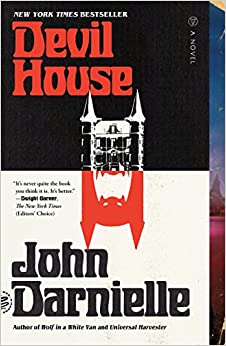
Devil House

The cover of the book shows an old house with two turrets silhouetted in black and white against a black background. Beneath it, against a white background, is a red outlined reflection of the house's shape, illustrated to resemble a vampire bat. The red and black lettering is in a Gothic style and gives the cover a retro, pulpy feel.

It’s changed since you were here, or else it hasn’t
It was special, it was deadly
It was ours and then it wasn’t

– The Mountain Goats

By Ben H.

An entertaining book full of mystery, empathy, and suspense, Devil House is also a thoughtful examination of authorial responsibility. John Darnielle excels at building meaning by layering stories. As the frontman of The Mountain Goats, he’s a storytelling genius. He’s magical and efficient. He’s an all-time great songwriter.

Speaking of authorial responsibility, I should state upfront that I think Darnielle is a better songwriter than he is novelist. Devil House would have benefited from heavy editing. That being said, I like the book and I consider my responsibility as the author of this review now satisfied.

Devil House is the story of true crime writer Gage Chandler. Chandler fictionalizes true stories for money, the job of all novelists, really, but he isn’t Thomas Wolfe writing about Asheville. Chandler writes the new Hulu documentary about a mother who poisoned her kids or a couple who killed boarders and buried them under the hyacinths. Chandler writes books that are adapted for the small screen and become the must watch shows of the week. He approaches the gruesome devil house murders of Evelyn Gates (the greedy landlord) and Marc Buckler (the sleezy real estate mogul wannabe) the same way he approached previous cases, but things get complicated.

The titular house is the center of the novel and serves as a cipher for all the characters. Chandler, Buckler, Gates, Seth, Alex, and Derrick all revolve around its foundations in one way or another. It’s Chandler’s next project; it’s work. Buckler and Gates see it as an asset or potential asset. High school students Derrick, Seth, and Alex use the abandoned house as a hideout. They make it a castle. It’s a safe place to sleep at night. Many of the highlights of the book occur when Chandler describes the boys and their relationship with the house.

Chandler’s methods are extreme. He’s the Daniel Day Lewis of true crime writers. Joaquin Phoenix ain’t got nothing on Gage Chandler. He lives where the crimes were committed (he literally moves into the building known as devil house). He holds items held by those involved as if they were talismans. He haunts eBay looking for paraphernalia tangentially connected to the case. He becomes the victims. He becomes the murderer. Chandler recreates lives based on evidence left behind. He imagines conversations and relationships based on the contents of a junk drawer. He establishes character and personality based on notebooks full of doodles. He gives his characters depth. He uses empathy to create details and narratives for his characters; but has he cold-heartedly monetized empathy?

While living in devil house, an old case that involves the murder of two students by their high school teacher, which Chandler turned into the book The White Witch of Morro Bay, comes back to haunt him. He receives a devastating letter from someone questioning his depiction of a certain character. Chandler prides himself on being fair to his characters, but how can you be fair to someone’s son when to you they are just a character you have partially fleshed out? His resolve shaken, he questions his methods and his career.

For those thinking that what this book sounds like it needs is a medieval section in middle English, you’re in luck! For me, this strange interlude emphasized the depth of the world-building that Derrick, Seth, and Alex were doing. It’s like I always say, “whan that Aprille with his shoures soote, / The droghte of March hath perced to the roote.” I also always say that if you can cut the section in middle English from the book you wrote in 2022, you should.

As in Wolf in White Van, Darnielle moves back and forth in time, weaving patterns and stacking stories. The payoff is well worth it. I reread the reveal a couple of times because it was so satisfying. The obvious takeaway for me was a critique of true crime books, shows, and movies. Devil House also offers a commentary on how society treats its vulnerable members. Whatever meanings you find inside Devil House, I think you’ll enjoy exploring most of its pages.

Harbor me when I’m hungry
Harbor me when I’m hunted

– The Mountain Goats

Ben Hamilton works at Project Literacy, Howard County Library’s adult basic education initiative, based at HCLS Central Branch. He loves reading, writing, walking, and talking (all the basics).

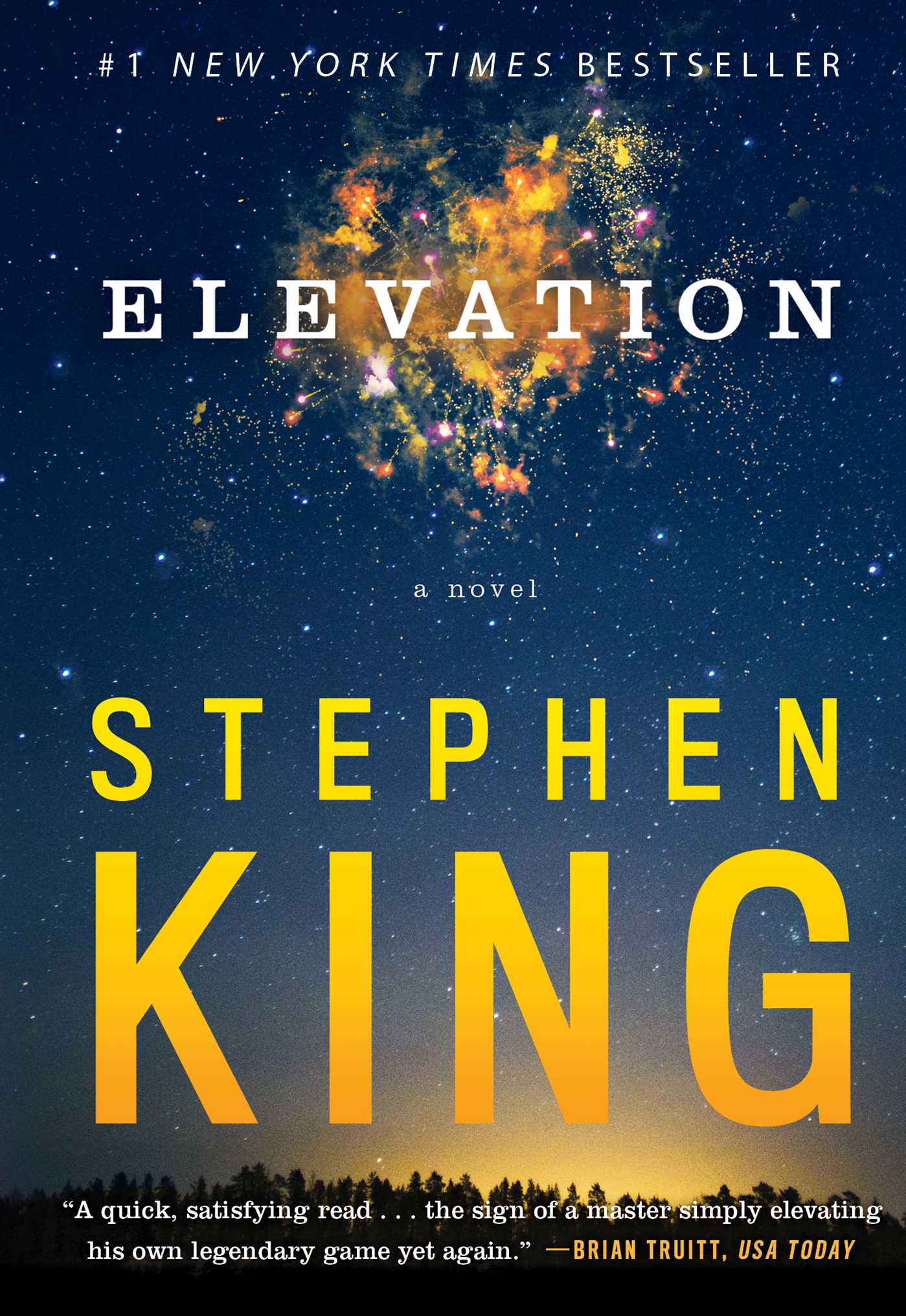
Elevation by Stephen King

A deep night sky shows a sort of explosion, the tree line at the bottm is also illuminated.

By Gabriela P.

Short on time? So is Scott Carey, the main character of Stephen King’s novella, Elevation. Forty-two years old and in relatively good health despite a disposition towards being heavy-set, Scott discovers he is afflicted with a strange condition where he continuously loses weight but not mass. Eventually, he comes to understand that, soon, he will literally be leaving the physical Earth as his weight plummets. With a divorce in his recent past, a too-large house, and a complacently settled routine in the town of Castle Rock, it takes two new neighbors moving in down the street to spur the unfolding of a moralistic but heartwarming comedy.

Scott’s two new neighbors are women. In his small town, same-sex relationships are at best tolerated…but same-sex marriage becomes a root for tension, gossip, and outright hostility. Scott himself bears no ill-will towards Deirdre and Myra, except a slight annoyance with their dog’s preferences for his lawn. When he confronts the two, he is received coldly, a result of a necessary guard the two have had to put up in the face of prejudice.

Unlike the plot development one might expect from a Stephen King story, Elevation does not dive into the wild undoing of a man and a town, but instead comedically highlights one man’s gradual, though admittedly somewhat naive, social enlightenment. While Scott Carey literally begins to leave the ground, he is also able to figuratively rise above prejudice. To really tug at the heartstrings, readers should consider the irony of strengthening bonds and belonging with an inevitable end.

Also available as eBook, eAudiobook on Overdrive and CloudLibrary, on CD, and in large print.

Gabriela is a customer service specialist at the Miller Branch. She loves long walks, reading with her dog, and a good cup of coffee.

Everyone in This Room Will Someday Be Dead by Emily Austin

A pale yellow cover features bunnies in many poses and many colors, with the title in a quirky script.

By Sahana C.

This book is cathartic. It feels like therapy, except things get way worse, more cringey, and infinitely harder to handle before the payoff hits, and all of the suffering of the previous two-thirds of the book ease into something manageable and even likable.  

I will not lie – I judged this book by its cover. There was something about the whimsical nature of the rabbits juxtaposed with the bold cursive proclaiming “everyone in this room will someday be dead” that struck me. What room? The very room I was in? I looked around the adult fiction section of the Savage Branch surreptitiously to see who was nearby. I went back up to the front desk, still holding onto the book, and thinking, “Yeah, actually, that’s true.”  

Dear Reader, obviously. This is not a new concept, that everyone, one day, dies. But sometimes, a book like this will bring this into perspective, throw a new light on something you know deep down but don’t consider very often. Emily Austin’s debut novel has moments I’m sure she would categorize as semi-autobiographical (I threw the “semi” in there for her sake, as the main character, Gilda, is truly a disaster), especially since there are moments in the book that I felt were semi-autobiographical and was alarmed at how close Gilda had gotten to my reality.  

Emily Austin was not referring to the Savage Branch when she was referencing her room. She was talking about every room Gilda, a noted hypochondriac, ever walked into. Gilda is a twenty-something lesbian and atheist, well known in the emergency room at her local hospital to the point that the janitorial staff know her by name. When we first meet her, she has just been in a car accident and broken her arm, a more physically obvious issue than the anxiety that normally brought her in for a check-up. In an attempt to get her anxiety under control, Gilda follows a flyer for free therapy to a Catholic church, where she meets Father Jeff and accidentally gets a job instead of therapy.  

From there, Gilda searches for a missing cat, deals with her younger sibling’s deteriorating mental health, tries to keep her old friends, tries to pretend like she’s Catholic, well-meaningly catfishes an old woman, and tries to solve a murder mystery that might not have involved murder, actually, all while trying to stay afloat.  

I read this on a long plane ride, which perhaps compounded the feeling of claustrophobia as Gilda kept tangling herself further and further in her web of lies. It meant that as I was reading an especially cringey section and closed the book for a moment, I couldn’t get up and go for a long walk, like I normally do. I was confined to the middle seat, stuck between two people who were fast asleep and were completely unaware of my distress, and, much like Gilda, all I could do in that moment was keep going. Keep reading and hope that somehow, something was going to get better.

Thank goodness it did, because otherwise, also like Gilda, I probably would have had a nervous breakdown. This book is wholly about the existential dread that comes with being an adult and looking around to realize your general existence is not exactly what you thought it’d be, then figuring out how to cope with that anyway. 

I would like to make it very clear that I do, indeed, like this book. I want everyone to read it, despite how difficult it can be. I’ve been recommending it to everyone, describing it as “anxious queer fiction” and asking friends, “Have you ever felt completely directionless and stuck? Well. Gilda will make you feel better. Because she had it worse.” I think if we all take a moment to reflect, the way Gilda does, on the way things are going, we might not always like what we see, but at least we know that we’re not alone in our discontent.

(And if you really want to feel like you’ve got a community, look at the Goodreads reviews for this book here.)

Everyone in This Room Will Someday Be Dead is available in print and eBook

Sahana is an Instructor and Research Specialist at the Savage Branch. She enjoys adding books to her “want to read” list despite having a mountain of books waiting for her already.

Author Works: Sarah Gailey

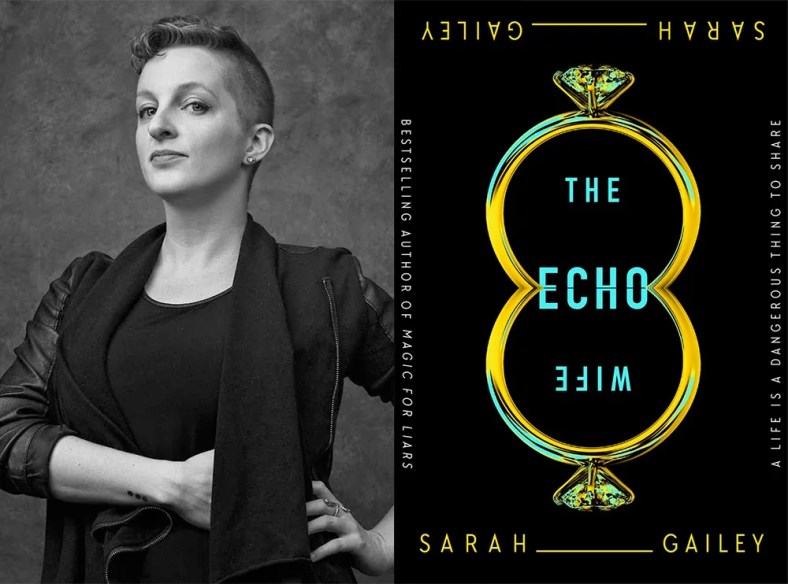
Black and white photo of the author, with short hair and one hand tucked inside her jacket, sits next to a cover of The Echo Wife. The cover shows an engagement ring and its reflection in gold with blue highlights, the title appears in blue inside the rings.

Tue, May 17 at 7 pm online
Register at bit.ly/echowife.

by Kristen B.

Author Sarah Gailey discusses their acclaimed novel The Echo Wife (also eBook and eAudiobook) in conversation with Maggie Tokuda-Hall, author of Also an Octopus (reviewed here). Gailey’s most recent novel, The Echo Wife, and first original comic book series with BOOM! Studios, Eat the Rich, are available now. Other shorter works and essays have been published in Mashable, The Boston Globe, Vice, Tor.com, and The Atlantic, and their work has been translated into seven languages and published around the world.

Publisher’s Weekly review of The Echo Wife:

This creepy, exhilarating science fiction outing from Gailey (Magic for Liars) dissects an unconventional affair that violates both a couple’s marriage vows and scientific integrity. Dr. Evelyn Caldwell is startled to discover that her husband, Nathan, has been seeing another woman—and even more shocked to learn that the other woman is a clone of Evelyn herself. Nathan created Martine to be everything Evelyn isn’t: attentive, submissive, and family-oriented. Adding insult to injury, Nathan used Evelyn’s own research to do so. An explosive confrontation among the three ends in Nathan’s murder, leaving Evelyn and Martine forced to work together to cover up the crime. It’s a situation that is not entirely unfamiliar for Evelyn, whose troubled past is teased out bit by bit. The women slowly discover that Nathan was hiding more secrets than either of them knew, forcing Martine and Evelyn to think on their feet in order to save themselves and the odd little family they create along the way. Gailey’s story unspools as a series of dark reveals that leave both the characters and the audience reeling. Readers won’t want to put this one down. (Feb.)

Gailey is a Hugo Award winning and bestselling author of speculative fiction, short stories, and essays. They have been a finalist for the Hugo, Nebula, and Locus awards for multiple years, and their bestselling adult novel debut, Magic for Liars, was published by Tor Books in 2019.

A bright pink cover shows a black hand upside down with its fingers crossed and a mystical eye on the wrist. the title of the book frames it in large yellow layers.

My book club (Books on Tap) read Magic for Liars for our May meeting. As with many other of Gailey’s books, it doesn’t fit neatly into one category. Yes, it’s a murder mystery complete with clues, red herrings, multiple suspects, and gory details. The book also tackles grief, illness, and how families deal with both. These weightier topics rather sneak around the edges of the crime scene. Our protagonist and Private Investigator, Ivy Gamble, is hired to solve the death of a teacher at the school for magical students where her sister teaches. She tells us up-front that she’s a liar, that she resents the living daylights out of her magical sister, and that she’s not proud of how the situation resolved. To say they are estranged doesn’t begin to cover the levels of distrust and bitterness that separate these twin sisters – one magical, one not. Do you trust that sort of narrator? It’s a terrifically entertaining read that nonetheless leaves you thinking about what you might do in a similar situation.

Magic for Liars is available in print, as an eBook and an eAudiobook.

You’re Invited! Evening in the Stacks: Across Africa

Event Logo incorporates a textile pattern in blue, orang, and cream along with the title "Across Africa" in script next to a silhouette of the continent.

Join us on Saturday, May 14 at 7 pm for this year’s gala fundraiser! Taking place at our East Columbia Branch, Evening in the Stacks features authentic cuisine, an African marketplace, an open bar, a DJ and dancing, and so much more. We will celebrate the continent of Africa – from the Mediterranean coast and the Nile in the north to the cities, grasslands, and deserts in Central Africa to the rainforests of the south.

Tickets at a new price are on sale now.

Black tie is optional for all guests and formal African attire is welcomed for those who are part of or identify with an African culture. Evening in the Stacks is a fun party that raises money for Library initiatives. This year, our goal is to raise $150,000 to benefit the creation of welcoming and inviting teen spaces in the Library’s six branches. 

We are also highlighting two spectacular authors, who are participating in a virtual author panel in conversation with Elsa M. on Tuesday, May 10 at 7 pm.

Young Black man dressed in dark blue pants and a grey sweater show seated in a park, leaning against a memorial black. He is bald and wears glasses.
Tope Folarin by Justin Gellerson

“I think the most important message in the novel is about Identity Construction,” says Tope Folarin discussing his debut book A Particular Kind of a Black Man. “All of us have that option in the 21st century. Tunde, the protagonist in my novel is forced to construct a persona because the persona he inherits from his father and society doesn’t match who he actually is.” (Simon & Schuster Books)  

Living in small-town Utah has always been an uneasy fit for Tunde Akinola’s family, especially for his Nigeria-born parents. Though Tunde speaks English with a Midwestern accent, he can’t escape the children who rub his skin and ask why the black won’t come off. He spends the rest of his childhood and young adulthood searching for connection—to the wary stepmother and stepbrothers he gains when his father remarries; to the Utah residents who mock his father’s accent; to evangelical religion; to his Texas middle school’s crowd of African-Americans; to the fraternity brothers of his historically black college. In so doing, he discovers something that sends him on a journey away from everything he has known. 

Winner of the Whiting Award for Fiction, A Particular Kind of Black Man is a beautiful and poignant exploration of the meaning of memory, manhood, home, and identity as seen through the eyes of a first-generation Nigerian-American. 

Based in Washington D.C., Tope Folarin is the Executive Director of the Institute for Policy Studies and the Lannan Visiting Lecturer in Creative Writing at Georgetown University. He also serves as a board member of the Avalon Theater in Washington DC, the Vice President of the Board of the Pen/Faulkner Foundation, and as a member of the President’s Council of Pathfinder. He was educated at Morehouse College and the University of Oxford, where he earned two Masters degrees as a Rhodes Scholar. 

Headshot of author against a grey background, where the author wears a vivid pattern in green and dark pink. She is looking off to the left.
NoViolet Bulawayo by NyeLynTho

Glory was inspired by the unexpected coup, in November 2017, of Robert Mugabe, Zimbabwe’s president who took office in 1980 and never let go the reins of government. The rhythms and pace of the novel are enthralling and extraordinary, narrated by a chorus of animal voices. As the book begins, Old Horse stands in for Mugabe, with an entire host of donkeys, pigs, and other creatures forming the political court around him, each one wanting to maintain their own power at the expense of others. Inevitable echoes of George Orwell’s Animal Farm occur throughout Bulawayo’s novel, but the voice is purely her own. She gives us characters with names such as Marvellous and Destiny, and allows us to (re)discover the delight of breathtaking political satire.

A review in The Guardian explains, “even the stylistic use of the refrain “Tholukuthi”, meaning “only to discover” (as in, “you thought you were getting a novel as good as We Need New Names, tholukuthi Bulawayo’s second is even more dazzling”), nods to a social media moment. Around the time of the Zimbabwe coup, the song Tholukuthi Hey! was released, and once it went viral, the refrain became a meme. “Tholukuthi” serves both as incantation and a form of punctuation in a novel that will appeal across generations.”

NoViolet Bulawayo is the author of two novels, including the most recently published Glory and the PEN/Hemingway (among others) award-winning We Need New Names. Her first book was also shortlisted for the International Literature Award, the Man Booker Prize, and the Guardian First Book Award. NoViolet earned her MFA at Cornell University and has taught fiction writing at Cornell and Stanford Universities. She grew up in Bulawayo, Zimbabwe and is currently writing full-time from the wherevers.

The Pull of the Stars

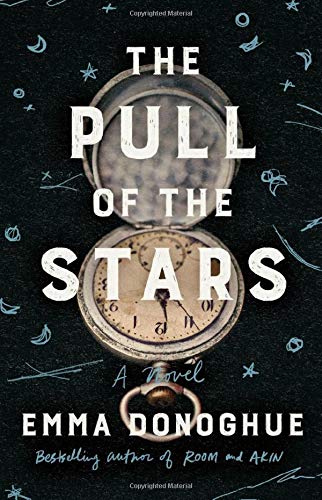
The cover shows an old-fashioned, open pocket watch against a dark blue background, with simple hand-drawn celestial objects including moons, stars, and planets scattered around it.

By Julie F.

Many novels depict the brotherhood of men at war. Donoghue celebrates the sisterhood of women bringing life into the world and those who help them along this perilous journey.” – Wendy Smith, The Washington Post, July 21, 2020

The Pull of the Stars by Emma Donoghue mesmerizes in the best possible sense. Both the pacing and the claustrophobia of this novel are intense – but it’s claustrophobic in a way that fully serves the plot, as the reader finds themselves in the tiny, overcrowded pandemic maternity ward of a Dublin hospital in 1918, basically the size of a closet, with the Spanish flu raging and World War I coming to a close. The little room is witness to so much – grief, pain, joy, love, trauma, fear, friendship, teamwork, unity, discovery – with the stories of nurse Julia Power and her influenza-ridden patients at the forefront of the action. The reader is propelled through the story, into this place where the characters’ trials and triumphs, representative of those experienced by women across the globe and across millennia, are so poignantly described. It is a story that will impress the reader with its introspective attention to detail and historical accuracy.

Nurse Power is a formidable character: efficient, tenacious, fearless, full of seemingly inexhaustible reserves of energy. Yet she is still young and, although not naive, full of uncertainty in a world where children randomly end up orphaned, babies and/or mothers die in childbirth, unequal outcomes are dependent upon wealth and social class, and soldiers like her brother Tim return from the war front unable to speak – or don’t return at all. She tries so hard to keep a cheerful spirit for her patients and for her young volunteer, Bridie Sweeney, yet at one point finds herself asking, “Back to this moment – what would be asked of me this morning?” (169). Her story echoes those of countless women who served their communities and countries in wars past, nurses and doctors and midwives and ambulance drivers who never shirked what was asked of them.

Post-2020 readers will find much of the pandemic description sad and uncannily eerie; Donoghue delivered the manuscript to her publishers in March of 2020, two days before Covid was declared a pandemic. But at heart, while still managing to address the random heartaches individuals experience in a world rent asunder by war, disease, and traumatic personal loss, The Pull of the Stars remains a hopeful, inspiring story (as is the author’s more famous and equally claustrophobic Room), about women’s solidarity and strength when tackling what seem to be insurmountable medical issues.

The Pull of the Stars is availalble from HCLS in print and large print, and also as an ebook and an eaudiobook from Libby/OverDrive.

Julie is an instructor and research specialist at HCLS Miller Branch who finds her work as co-editor of Chapter Chats very rewarding. She loves gardening, birds, books, all kinds of music, and the great outdoors.

National Library Week: Connect with Our Library!

National Library Week logo: Connect With Your Library. Connect is a white mouse with cord on a blue background. A black and white image of a plug on a deep yellow goes with "with your, and "library" is on red with an illustration of two hands getting ready to clasp.

Those of us who write for Chapter Chats want to connect with you, and want you to connect with the library. Most of the time, we’re going to share with you something new and different to read or watch. We enjoyed those titles so much that we want you to experience them, too. Check out recent popular reviews of the The Thursday Murder Club by Richard Osman or A Song of Wraith and Ruins by Roseanne Brown. If you’re an audiobook listener, we have you covered as well.

But the library has so much more to offer than books, and we want you to know about those things, too. Here’s a brief list of some blog posts that look at the other ways we’d like to connect with you:

Have you had a chance to visit Central Branch and tour the Undesign the Redline exhibit? It’s only here a little bit longer. Christie Lassen talks all about it in this Interview.

Have you been to Glenwood Branch recently? There’s so much that’s new for you! Visit the Makerspace and see the wonderful new play stations.

Our most liked blog post since Chapter Chats began about two years ago lets you know how to use the library’s subscription services to avoid news paywalls.

Do you like to craft? Or maybe bake? The DIY Center at Elkridge Branch may be able to help. The staff there can also help you with tools to get your yard cleaned up after winter and ready for spring fun.

And, now that it’s actually spring and random snow flurries have finally ended, take a drive to Ellicott City to visit the Enchanted Garden at HCLS Miller Branch.

One of our teen volunteers who frequents the Savage Branch (and writes for the blog) recently discovered that we lend toys. She is entirely on board with this idea.

We are even bringing the library to you with our PopUp Library van, which visits neighborhoods and community events.

So, take this as a reminder and an invitation to stop by frequently and see what’s going on in the blog – and at the Library. We love our library and connecting with you in all the ways we can imagine.