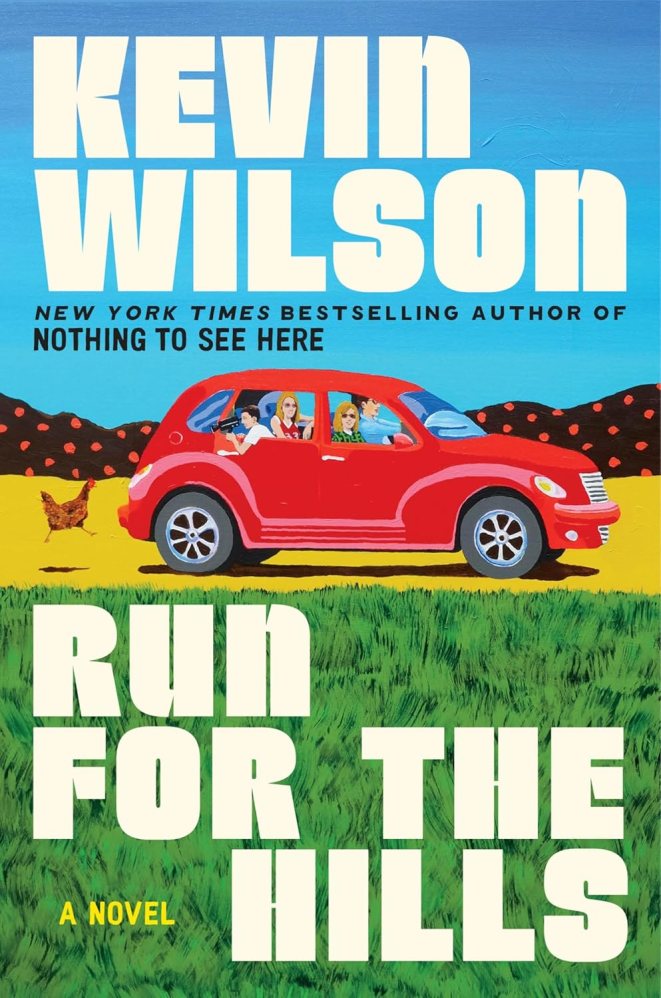
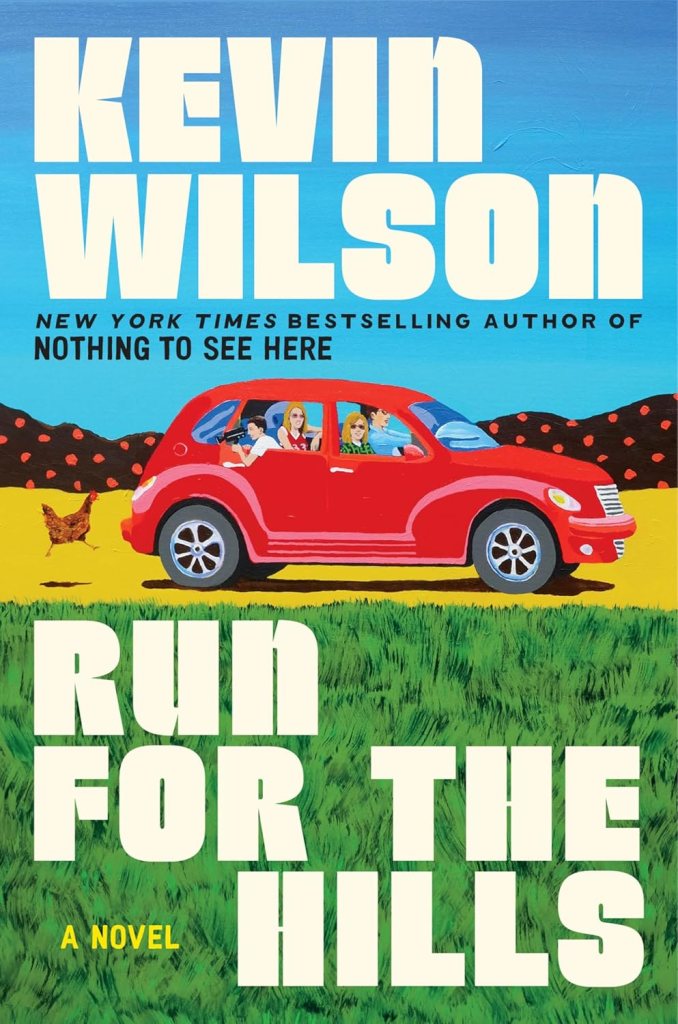
Run for the Hillsby Kevin Wilson is the story of what might be the weirdest road trip ever conceived. If “found family” is a popular theme in books these days, what do you call it when you actually find your family? As in siblings you never knew existed.
Reuben Hill drives a rented PT Cruiser and is on a quest to locate his father, who disappeared when he was a child, and his half-siblings who live across the United States. Here’s the catch: the siblings don’t know that each other exists. Rube (nicknames are a thing) hired a private investigator after his mom died to get some answers to his life’s mysteries. He finds Madeline Hill (Mad) working the roadside stand at the organic farm in Tennessee where she and her mom live. From there, they head to Oklahoma to find the next sister (Pep, which is short for Pepper), who plays women’s collegiate basketball at the highest level. Then, on to Utah and finally to California.
It’s a quirky setup, filled with snacks and shared life experiences. Their mutual father (Chip, Chuck, Charlie, Carl Hill) left each of his families, although he still keeps in contact with the moms, as he headed ever further westward. The Hill progeny are all blessed with strong mothers – not perfect, but certainly able single parents. Each child has mostly fond memories of their father, but also justifiable frustration and anger over his abandonment of them. With each new family, Mr. Hill became an expert enthusiast in a different area – from writing to farming to basketball to film.
When the book wraps up at a wealthy wilderness retreat in California, the Hill half-siblings really, truly feel like family to one another. Sometimes exasperated, but always lovingly so, they realize that their connections to each other matter – maybe more so than the relationship to their missing parent. They have each already grieved and processed that fact of life to greater or lesser extents. About that missing parent: I will give author Wilson full credit for NOT redeeming him entirely. While I was left wanting more about this bunch of cool, nerdy, confused but ultimately good-hearted folks, it was a lovely summer read filled with good emotions and hope. There’s nothing weird about that.
Run for the Hills is available from HCLS in print and as an e-book and an e-audiobook from Libby/OverDrive.
Kristen B. is a devoted bookworm lucky enough to work as the graphic designer for HCLS. She likes to read, stitch, dance, and watch baseball (but not all at the same time).
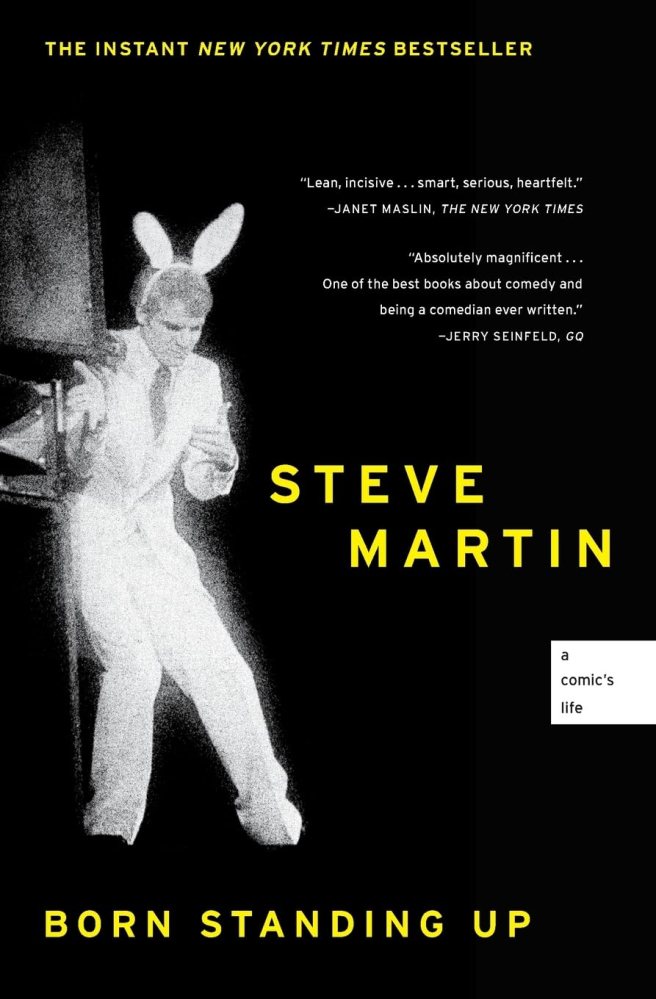
Steve Martin is best known as an accomplished Hollywood actor, recognized as the star of classic comedies like Father of the Bride, Three Amigos, and Cheaper By The Dozen, but some folks may remember his brief time as a standup entertainer. In fact, Martin achieved national stardom through his standup work, released four comedy albums (Let’s Get Small and A Wild and Crazy Guy sold millions of copies), and established national catchphrases, such as, “well excuuuuse me”. His acting career only began after he burned out from that stardom, and Martin seeks to revisit those beginnings in his new memoir.
Born Standing Up focuses on the early life and career of the Hollywood multi-hyphenate. He comes of age in California; his first jobs included selling guidebooks at Disneyland and performing in a comedy troupe at Knott’s Berry Farm. His surreal sense of humor got him a position as a writer for the Smothers Brothers Comedy Hour, which kept him afloat while his “experimental” standup comedy struggled in California clubs and on late-night TV appearances. Against the blunt advice of his agent (“stick to writing”), he quit writing to take his performances on the road.
Steve Martin’s standup comedy was weird, conceptual, nonsensical, and almost completely unique. There were props, he was a master juggler, and he played the banjo. He was a consummate entertainer, but his work was intellectual too; his friend Rick Moranis termed it “anti-comedy.” He had a theory behind his performances: “What if there were no punch lines? What if there were no indicators? What if I created tension and never released it?… What would the audience do with all that tension?… if I kept denying them the formality of a punch line, the audience would eventually pick their own place to laugh, essentially out of desperation.”
Some typical Martin one-liners:
“I’m so depressed today. I just found out this ‘death thing’ applies to me.”
“Here’s something you don’t often see:” [spreads mouth open with fingers, and leaps into the air while screaming]
“I think communication is so firsbern.”
The driving force of Martin’s life during this time seems to be either deep dissatisfaction or reckless ambition, as he constantly abandons his own comfort to try his hand at success. Martin seems more motivated by the idea of mastering his craft than by fame and fortune. He taped his shows on cheap cassette recorders so he could listen back and master his timing, obsessing over how to make audiences “get” his weird material better. He found the uncharted territory of playing those clubs exciting as he refined his craft, but the constant work was met with lukewarm results. It clearly took a toll on him,“ When I think of moments of elation I have experienced over some of my successes, I am astounded at the number of times they have been accompanied by elation’s hellish opposite.”
He finally broke through and his inventiveness was widely recognized, but he lost the thrill of winning over those tough, small audiences. He now performed in arenas to crowds who were eager to recite his catchphrases and punchlines at him. “The nuances of stand-up still thrilled me, but nuance was difficult when you were a white dot in a basketball arena. This was no longer an experiment; I felt a huge responsibility not to let people down… I dabbled with changes, introducing a small addition or mutation here or there, but they were swallowed up by the echoing, cavernous venues.” Stardom made him terribly lonely and deeply exhausted. He was determined to use his stardom to try to find success while he could, and he pitched a tentative screenplay for The Jerk to Paramount. Carl Reiner signed on to direct, the film became a smash hit, and the rest is history.
This obsession with self-improvement, artistic satisfaction, mastery, and success seems to stem from family issues: Martin is clearly haunted by his parents. His father, who physically disciplined Martin, sometimes indiscriminately, could barely acknowledge his son’s fame and success and would only do so disparagingly. His mother was clearly happy that her son became a star, but her compliments took an oddly backhanded form: “Oh, my friends went to the movies last weekend, and they couldn’t get in anywhere so they went to see yours, and they loved it!” The book ends with the deaths of each of his parents, with him at their sides, attempting to bring closure to the trauma and understand why they shaped each other the way they did.
When you’re reading a comedian’s memoir, you usually expect an entertaining, light read with some poignant biographical vignettes to add a little gravitas. Born Standing Up reverses the ratio of jokes to earnestness. Not only does Martin impart a tremendous amount of wisdom and pain from his life experiences, he offers some of the most profound and thoughtful writing I’ve read in a long time. Martin reserves the jokes for either explaining the details of his standup material or making light of awkward life situations he found himself in, and I never really minded.
Born Standing Up is available in print or as an audiobook read by the author.
Alex Pyryt is a DIY Instructor & Research Specialist at HCLS Elkridge Branch.
Are you a historical romance fan who is waiting impatiently for the next season of Bridgerton? A reader of Loretta Chase or Sarah MacLean on the hunt for a new author? Look no further than Martha Waters and her Regency Vows novels.
There are five books in this loosely linked series. The first two, To Have and To Hoax and To Love and To Loathe, are delightful stories with witty conversation and clever turns of plot. To Marry and To Meddle, however, is my favorite so far. Not being a regular romance reader (I’m more of a British police procedural fan), I’ve been pleased to find them all so clever and enjoyable.
Lady Emily has always deferred to a very proper mother who is full of (unreasonable) expectations for her daughter; Lord Julian is a ne’er-do-well who owns a theatre and is practically disowned by his father for doing so. When the two acquaintances are thrown together at a country house party, a hasty marriage of convenience ensues. Julian helps her escape her domineering family, and Emily cloaks him in respectability – but will their relationship develop further, and will their families come to accept them as they are? Of course, the lovers are at cross-purposes for much of the novel; Julian, who initially views Emily’s interest in his business as her opportunity “to meddle,” may or may not come to accept and even value Emily’s innovative ideas and contributions to his theatre. Emily, in turn, hopes that her status as a young bride will give her time with her new husband and a chance to make a difference outside the traditional, accepted realms of ballroom and drawing room.
I liked the sharp wit and also the gentle playfulness of the story – including antics involving a stray kitten nicknamed Cecil Beelzebub Lucifer by his lordship. The main characters, who are winsome and intelligent, are exceptionally strong and well-rounded; even though they live in a very different time and place, the author is skilled at making them relatable, creating deft portraits of real people with both dilemmas and personal triumphs through dialogue and description.
Author Martha Waters does a great job of tying the series together through each set of lovers in a broader group of aristocratic English friends, and I’m already looking forward to the next one, To Swoon and To Spar – which will feature Viscount Penvale and his uncle’s ward, Jane Spencer – followed by To Woo and To Wed.
To Marry and To Meddle is available in print and as an e-book from Libby.
Julie is an instructor and research specialist at HCLS Miller Branch who finds her work as co-editor of Chapter Chats very rewarding. She loves gardening, birds, crime and espionage fiction, all kinds of music, and the great outdoors.
John Irving’s In One Person is a moving and powerful exploration of identity, sexuality, and the quest for acceptance. At its heart is Billy Abbott, a bisexual man reflecting on his life. The novel chronicles Billy’s life from age 13 in the 1950s to his late 60s in 2010. Rather than following a strict chronological order, Irving skillfully weaves the narrative, shifting between pivotal moments in Billy’s journey to create a more authentic, lifelike portrayal.
From Miss Frost, the enigmatic librarian who plays a pivotal role in Billy’s awakening, to Richard Abbott, his stepfather and a source of guidance and support, each character is richly drawn and adds depth to the narrative. Irving’s portrayal of these relationships is nuanced, highlighting the importance of connection and the impact of those who accept and understand us.
Irving does not shy away from addressing the prejudices and challenges faced by the LGBTQ+ community. Through Billy’s eyes, readers witness the AIDS crisis, shifting attitudes towards sexuality, and the enduring struggles for acceptance. In One Person’s exploration of these themes is both heart-wrenching and hopeful, offering a candid look at the progress made and the work that remains.
Fans of John Irving will recognize his signature style: the blend of humor and tragedy, the richly detailed settings, and the intricate plotting. Irving’s ability to create a world that feels both specific and universal is on full display, making Billy’s journey relatable to readers from all walks of life.
When I first read In One Person I was incredibly drawn to how Billy goes to the library (thus meeting Miss Frost) seeking novels about “crushes on the wrong people.” She starts him out with Wuthering Heights and Jane Eyre, but expresses less confidence in giving him Henry Fielding’s Tom Jones, something I both love and laugh at at every time. Anyone who has ever had a crush on the “wrong person” will probably crush, even if just for a bit, on this too.
Angie is an Instructor & Research Specialist at Central Branch and is a co-facilitator for Reads of Acceptance, HCLS’ first LGBTQ-focused book club. Her ideal day is reading in her cozy armchair, with her cat Henry next to her.
My Roommate is a Vampire by Jenna Levine is a fang-tastic blend of humor, romance, and supernatural charm that leaves you thirsting for more. From the very first page, this novel sinks its teeth into you with witty banter and irresistible characters. Our protagonist, Cassie Greenberg, is an artist struggling to make ends meet in Chicago. Just when her situation seems dire, she stumbles upon an unbelievable Craigslist ad for a rent-free apartment. The catch? Her new roommate is Frederick J. Fitzwilliam, a suave and sophisticated vampire who’s been asleep for a century.
Levine does a magnificent job weaving modern-day struggles with age-old vampire lore. The chemistry between Cassie and Frederick is electric, with their playful interactions and evolving relationship keeping readers hooked. Cassie’s vibrant personality and Frederick’s old-world charm make for a delightful contrast, and their journey from strangers to something much more is heartwarming and full of surprises. The novel’s humor shines through in every chapter. Whether it’s Cassie teaching Frederick the wonders of modern technology or Frederick’s awkward attempts to fit into the 21st century, the laughs come naturally and frequently. The supporting characters add depth and color to the story, each bringing their own quirks and perspectives.
My Roommate is a Vampire isn’t just a lighthearted romp; it also explores deeper themes of acceptance, adaptation, and finding one’s place in an ever-changing world. Levine’s writing is sharp, clever, and full of heart, making it easy to get lost in Cassie and Frederick’s world. Perfect for fans of paranormal romance and anyone looking for a feel-good story with plenty of humor, this tale makes you believe in love that transcends time.
Angie is an Instructor & Research Specialist at Central Branch and is a co-facilitator for Reads of Acceptance, HCLS’ first LGBTQ-focused book club. Her ideal day is reading in her cozy armchair, with her cat Henry next to her.
Have you ever worried that you’ll trip and fall and inadvertently bite your tongue off? Or that you’ll sneeze so hard with your eyes open that your eyes will pop right out of your head? Do you ever secretly worry that there could be invisible people in your bathroom?
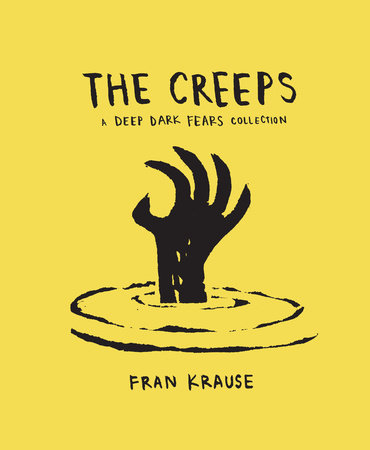
In Deep Dark Fears and the follow-up collection The Creeps, cartoonist and illustrator Fran Krause brings some of our greatest — and some of our silliest — fears to life in charming ink and watercolor comics.
Some might recognize the concept from Krause’s popular web comic “Deep Dark Fears,” which continues to run on his Tumblr and Instagram accounts. Readers, sometimes anonymously, submit their occasionally bizarre and often relatable fears for Krause to illustrate, typically in a classic four-panel comic strip. The result is a delightful mix of the macabre and the comical.
In one comic, Krause depicts a reader’s secret fear that all of life is a simulation. In another, our protagonist admits to wondering if there are hidden cameras in public automatic-flush toilets that snap clandestine photos of every visitor. Finally, in a surprisingly heart-wrenching turn, a particularly memorable vignette follows the ghost of a dead dog who has returned to their owner, who can’t see them, leaving the ghost pup to wonder why they’re being ignored. (If reading that doesn’t send a chill down your spine and make you go and hug your pet, nothing will.)
There are also the laugh-out-loud funny fears: being told as a kid that the steam rising from the pork dish you were served for dinner is just the pig’s ghost floating away, or that if you eat candy in bed at night, ants will crawl into your ears while you’re sleeping and build a colony in your head.
Embrace your fears — and maybe even discover a few new ones — and borrow one of Krause’s collections from the Library today.
Sharon Pruitt-Young is an Instructor and Research Specialist at East Columbia Branch. Aside from books, she is passionate about writing, urban sketching, trees, and art of all kinds.
It is always exciting for me to read a fabulous story written by a debut author. Natalie Sue has done a tremendous job in her first novel, I Hope This Finds You Well, to drive home the point that everyone around us has a unique story, fighting their own individual battles. As humans, we need to recognize that fact and show others some grace. But that is not always easy.
Jolene had a life altering experience in high school. As a result of that incident and the ramifications of it in society and in her head, she is stuck in her life. She is 33, stagnant in a confining job as an administrative assistant in a big corporation called Supershops. She lives in a decrepit apartment after finally moving out of her parents’ house. She drinks too much, lives a lonely life, and evades the intrusive texts of her Persian mother.
As we meet Jolene at the beginning of the story, it is hard to like her. Her petty coworkers are trying to back stab each other to climb the corporate ladder and, most importantly, to avoid the layoffs that are looming over them. Jolene’s way of coping with the nastiness at her workplace is writing unsavory comments about her colleagues in her official emails to them but changing the text color to white. When she forgets to change the color of the font in one of her emails to another administrative assistant, Caitlin, Jolene is called to HR for an intervention.
She must take mandatory training under a new HR guy, 33-year-old Cliff. Although Cliff is helpful and pleasant, Jolene does not trust him since he is part of the enemy, a.k.a management. As part of the training, IT must change some settings in Jolene’s computer, which backfires. Jolene finds to her surprise that she has access to all her coworkers’ work emails and chats. Through her prying, Jolene can see what changes are coming in the organization and what her coworkers think about her. This unexpected glimpse into private conversations gives Jolene a chance to maneuver her own actions to position herself to get the next promotion over her fellow administrative assistant.
It also gives her access to the secrets that her coworkers harbor. The correspondence of her coworkers reveals to her the challenges that all her coworkers struggle with in their personal lives. Cliff, the HR guy and Jolene become friends, but can they be more than that as there is definitely a conflict of interest in their respective roles?
The story is full of humor and observations of basic human nature. It is also full of love, loneliness, mental health challenges, eccentricities of people who surround us, the push and pull of second-generation immigrant experiences, and above all the human connections that free from our past.
Piyali is an instructor and research specialist at HCLS Miller Branch, where she facilitates two book discussion groups: Light But Not Fluffy and Global Reads. She keeps the hope alive that someday she will reach the bottom of her to-read list.
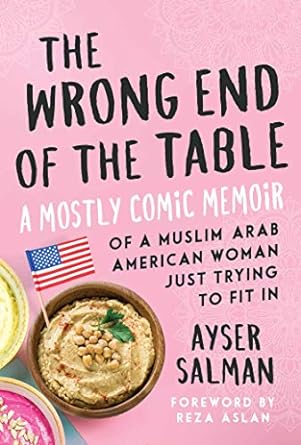
I always seek out memoirs written by immigrants, because I am curious whether my experiences in a new country mirror the experiences of others. Everyone’s life is unique; however, facing micro aggressions, intentional or unintentional, seems to be a common theme in each of our stories. That, and trying to find a place at the table. It takes time for immigrants to understand the culture and traditions of the country they emigrate to and it also takes time for them to be understood. An immigrant expends time and energy making sense of their new environment and is accepted (hopefully). The process is not seamless or easy, though. Often, we find ourselves at the wrong end of the table. Ayser Salman explains this beautifully in her memoir, The Wrong End of the Table: A Mostly Comic Memoir of a Muslim Arab American Woman Just Trying to Fit in.
The oldest child of an Iraqi family who fled the fascist regime of Saddam Hussein to give their children better opportunities in the United States, Salman found herself to be the only child in her Columbus, Ohio school of Arab descent, someone who had trouble pronouncing rr’s in the way that the English language demands. In Ohio, little Ayser discovered McDonald’s Egg McMuffins, Barbie dolls and, much to her surprise, kids playing doctor everywhere. This was also a time of struggling to fit in and assimilate with her blonde and blue-eyed White peers. Often confused, often treated differently, often facing derogatory comments about ‘her people’ being terrorists, Ayser Salman navigated through her life, pursuing her career in films and gaining strength of character as an independent Arab American woman. Her parents raised her to be a strong woman and a proud Muslim. While growing up, Salman felt misunderstood and discriminated against due to her identity as an Iraqi American woman, but once she understood intersectionality, she realized the extent of intersectionality existing in our society and felt like she belonged.
Her family, during her teenage years, moved to Saudi Arabia for a few years before returning to Lexington, Kansas. Despite the oppressive rules governing women during the 1980s in Saudi Arabia, Ayser found a sense of belonging among the girls she went to school with, as they shared her religion, culture, and traditions. In Saudi Arabia, she did not stick out like a sore thumb like she did in America. She related to the girls she went to school with, and they formed deep friendships as they experienced puberty together. It was a great irony that in a country where women were repressed, Ayser felt a certain kind of release.
Once Ayser left for college, she ceased being ‘different ‘ and found acceptance among her peers to some degree. College, unlike her high school, was a microcosm of the world, where people with diverse identities came together for higher education. There was a level of acceptance of differences that Ayser had never experienced before. But 9/11 brought new challenges and she again found herself at the wrong end of the table, vociferously trying to prove to the world that Muslims are not terrorists.
Ayser Salman talks about racism and micro aggressions in her memoir, but she coats them with a veneer of lighthearted, witty narrative. The racism is made more poignant due to her self-deprecating humor. She writes about her dating experiences with both Arab and non-Arab men, as well as her strong female friends who always had her back but sometimes failed to understand her culture or were insensitive about her Arab identity. She also pays homage to her fierce mother, her scholarly father, and her siblings. Ayser’s conversations with her mother made me laugh out loud, reminding me of similar conversations I have had with mine.
Ayser Salman’s writing is lucid and flows beautifully. Her humor in describing and responding to serious subjects makes the reading experience delightful. If you are interested in memoirs and/or learning about immigrant experiences like I am, this is a great book for you.
The Wrong End of the Table: A Mostly Comic Memoir of a Muslim Arab American Woman Just Trying to Fit in by Ayser Salman is available in print format.
Piyali is an instructor and research specialist at HCLS Miller Branch, where she facilitates Light But Not Fluffy and co-facilitates Global Reads. She keeps the hope alive that someday she will reach the bottom of her to-read list.
My man Jo Koy bombed as the host of the Golden Globes. As I was reviewing some of the clips, my heart fell. This was NOT the Jo Koy I knew. I can’t help wondering where it went wrong, and I felt even worse about the kind of awful press he was getting. Comments like “Who even was this guy?” and “What a loser!” kept popping up in these online clips. I felt myself wanting to defend him and to prove to people that Jo Koy was truly funny. Unfortunately, hosting gigs like that are tough. They can sour (or sweeten) the masses to you, especially as a comic. And goodness me, even I know that a friendly roast of Taylor Swift is a “no-no” these days!
If you get a chance to watch his numerous Netflix specials and pick up his book Mixed Plate, I believe you’ll gain more of an appreciation for Jo Koy. I am absolutely biased as I am also a “mixed plate” like he is – half Filipino and half white.
You know, aside from my brother and me, the only Jewish-Filipino person I had ever heard of in the 90s was Rob Schneider, one of our most beloved comedians. I heard of Jo Koy through Filipino friends and family who alerted me to the fact there was a Filipino American comic who was crushing it (thanks for the heads up). He’d been grinding for years and made his way onto “Chelsea Lately” as a panelist. I saw one of his specials on Comedy Central in the early 2010s and would continue to look for Jo Koy material and find random snippets on YouTube. Finally, by 2017, Live from Seattle was on Netflix. I shared this with my husband and he, too, has become a Jo Koy fan.
My family revels in comedians. We had cassettes of comedians that we’d listen to over and over. In fact, we had the same Richard Pryor cassette that Jo Koy references in this book. In the 90s I loved In Living Color, All That, and any comedy sketch show I could find. And SNL? SNL in the 90s was ripe with talent: Dana Carvey, Adam Sandler, Chris Farley, David Spade, and the rest of them. I remember Eddie Murphy in red leather, George Carlin and his bad words, and today I enjoy Jo Koy, Tiffany Haddish, Tom Segura, and others. When he finally “makes it,” he starts name-dropping his idols who soon become friends. Most surprising (and hilarious) is his friendship with Jon Lovitz!
Other revelations in this book proved to me just how incredible humor is. Some things make you laugh to keep from crying, and others make you laugh until your cheeks are wet with tears! The struggles in this book are so painfully real. There’s the struggle of not being enough, then there’s the struggle of not having enough. Growing up impoverished and mixed can amplify those feelings of not really belonging and simultaneously doing whatever you can to be seen. Jo Koy lived this reality, and I felt it in his words. Humor and shared experiences bring people together. There’s about seven pages of thank you’s at the end of this book, and it’s only a short testament to how much this book was created with love and gratitude. Jo Koy seems to have a happily ever after, and I’m here for it!
Mixed Plate is available from Howard County Library System in print and as an e-book.
JP has worked for HCLS since 2006. She enjoys gallivanting, Jollibee, and all the halo-halo she can eat.
This is a True story. The events depicted took place in Minnesota in 2006.
At the request of the survivors the names have been changed.
Out of respect for the dead, the rest has been told exactly as it occurred.
What defines the ‘truth’ of a story? Is it accuracy to the literal account of events, or that it resonates with a more elusive truth about our perceptions of ourselves and the world? Every episode of Fargo opens with the passage above, adjusted for the specific time and place of the season’s focal bedlam. Each season is independent, although loose connections unite each season into a shared world with Easter eggs for the eagle-eyed viewer. But each season is a ride along, a shocking and surreal crime wave that disrupts the deceptively quaint communities of the Midwest.
Watching Fargo is like having an intimate view into two trains hurtling towards an inevitable collision. It is tense and dramatic, unpredictable and quirky. As if the trains were full of seemingly supernatural criminal murderers and diffident Minnesotan house-spouses who would use phrases like “You betcha” and “Aw Jeez” even as the world burns down around them. A mix of crime drama and magical realism with a substantial dose of Minnesota Nice, all brought to a boiling point.
I cannot overstate my love for this series. The creative aesthetics behind the production are unlike anything else on TV. The sets are gorgeous; nigh-eternal winters loom over the Midwestern plains, enhancing a sense of stasis that stands in contrast to the rupturing of the status quo. The music fills the show with an exciting dynamism. The theme song is stellar, evoking a kind of folk melody that is nostalgic, yet somber and plaintive. As it pertains to the larger show, the music is curated to great effect. The soundtrack is a diverse mix of iconic songs of the time and original compositions, which all serve to influence the emotions of any given scene.
However, it is the writing that stands above all else. The framing device which opens each episode always fills me with anticipation. Borrowed from the original Coen Brothers’ film, the statement “This is a true story” calls to mind Truman Capote’s creative nonfiction novel In Cold Blood, which itself serves as a founding inspiration for true crime as a literary genre. Stories about crime have always drawn audiences, but true crime’s magnetism is unique. The next two lines of the opening comment on respect, for the living and the dead. The contrasting means of showing this respect are wryly humorous. One wouldn’t be remiss in wondering if the calls for respect are a means to an end so that the story can be told. Perhaps elements of these stories compel us to share them, as a lesson to be learned or a chance to understand something better.
However, contrary to the opening lines, Fargo is fiction. Many of us are familiar with films that take liberties with their claims of truthfulness (looking at you, The Conjuring). Fargo is different. The show revels in the contradiction of this deliberate and ironic narrative choice. This narrative flourish prepares the audience for a cavalcade of untrustworthy narrators. Truth is, unfortunately, not easily uncovered.
The police investigations which act as a through line for the series are not the pinnacle of competent detective work. There is neither a Sherlock nor a Hercule Poirot to be found. Instead, we are presented with a motley crew of eccentric characters possessed each by their own perspective, and everyone is wrestling for control. Their actions are influenced by their respective worldviews and the lengths they will go to ensure their particular truths remain unimpeachable. When these characters are pitted against each other, their perspectives paint a dynamic portrait of what it looks like to live in our world.
This interplay reveals discussions on all manner of philosophical and political topics. Uncovering the reference behind each episode title is a fun bonus game for an active viewer. I want to focus on one particular example from Fargo’s second season entitled “The Myth of Sisyphus.” Season two takes place in 1979 and covers the grisly collision between a hapless couple who accidentally killed a member of the local Gerhardt crime family, the vengeful crime family in question, the encroaching Fargo mob, and the state troopers who are trying to prevent the violence from spreading. The season opens with the words of Jimmy Carter:
It is a crisis of confidence. It is a crisis that strikes at the very heart and soul and spirit of our national will. We can see this crisis in the growing doubt about the meaning of our own lives. And in the loss of unity and purpose.
Fargo places Carter’s crisis of confidence in direct conversation with Albert Camus’ essay on Absurdism, “The Myth of Sisyphus,” with a handful of characters reading the essay.Camus’ essay discusses how we crave meaning and purpose in our lives but are confronted by a world that has no meaning and is defined by chaos. In the classic myth, Sisyphus was cursed to push a boulder up hill, which ultimately rolls back down once it reaches the top. Sisyphus must then return to the boulder and begin pushing it again. Forever. The myth represents futility and the struggle against meaninglessness. Arguably, none of the characters gained a great comprehension of this essay. Some of them flatly reject the framework of the essay, but nonetheless act in ways that exemplify Camus’ different propositions for responses to the Absurd. Through the contrasting reactions to the text and the responses to increasingly absurd circumstances, we see the show develop its philosophical inquiry into the issue.
This inquiry is not accomplished without a lot of heart. Fargo is ultimately hopeful. The largest source of friction, the catalyst of all chaos, stems from the inability to communicate and the resulting misunderstanding chips away at our sense of unity. Giving up is not an option, or at least, not a particularly good one. We make meaning in our lives through the things we cherish, that we wish to protect or pay our attention to. Whatever trial or tribulation, we face those challenges to preserve what is valuable. To do otherwise is tantamount to letting it fade.
Fargo is special for how it juggles this stylistic blend. It presents humor and horror together with sentimentality. None overshadows the other. Fantastic casting choices breathe life into the writing. No matter how quirky the characters may be, they embody a sense of realism that makes the world feel alive and not too distant from our own, especially now in our own bizarre and heightened reality. Sometimes, even truth must be disguised for others to regard it. Fargo uses the medium of fiction to bypass our skepticism and take us on a journey through and around the strange heart of the modern world. And it makes sure that the journey is going to be wild and fun along the way.
If your interest is piqued, the good news you can borrow the first three seasons of Fargo on DVD. Season 5 of Fargo is currently airing on FX and select streaming services.
Ian is an Instructor and Research Specialist at East Columbia Branch.He is a huge nerd with too many interests to list here. Currently, he is fixated on the interconnection between history and fiction. His favorite kind of stories are stories about stories.








 CHAPTER CHATS