
Alias Emma by Ava Glass

The book cover depicts a woman running across London Bridge at night, with her coat and long hair flying out behind her and several bright lights emanating from the bridge above her, shown against a cloudy, dark blue-green sky.

By Julie F.

Alias Emma by Ava Glass is a strong debut novel, a spy thriller with a lot of clever nods to the history of the genre. Even though Kim Sherwood has recently published two books in her series about a woman in the double-O universe (Double or Nothing and A Spy Like Me, both authorized by the Ian Fleming estate), you could reasonably consider Glass’s main character, Emma Makepeace, as part of a tradition of propulsive action and daredevil exploits reminiscent of Fleming’s James Bond. In terms of Emma’s quick thinking and survival skills, there are also shades of Emma Peel from The Avengers. Finally, Emma’s handler, Ripley, might make you think of two disparate characters who nonetheless pull all the strings and hold most of the cards in their respective fictional espionage worlds: the enigmatic George Smiley from John Le Carre’s novels and Mick Herron’s obnoxious but brilliant head of Slough House, Jackson Lamb. (Side note: It’s a testimony to the acting skill of Gary Oldman that he has portrayed both Lamb (Slow Horses) and Smiley (Tinker Tailor Soldier Spy) to great acclaim. Both are fantastic performances and well-crafted productions.)

Ava Glass sets a remarkable pace from the start in this non-stop story of a day in London, with Emma working to avoid compromised CCTV cameras (and the Russian spies who are monitoring them) as she tries to get across the city to the headquarters of the covert agency that secretly employs her. She’s towing a reluctant traveler along with her: Michael Primalov, a doctor whom the enemy has already attempted to kidnap or kill. Michael needs to be in witness protection because of his mother’s past history as a Russian scientist who traded secrets. Emma uses all of her smarts, tradecraft, gadgets, and skills to outwit the villains at every turn. The duo hope to connect with Emma’s supervisor, Ripley, but when they don’t know who to trust, even communication via regular secret channels is fraught with danger. At moments, this wild tale might make the reader feel like the pair couldn’t possibly cope with one more setback as Emma and Michael avoid explosions, are chased by Russian assassins, and even take a detour into the famous tunnels of subterranean London. If the reader is willing to suspend their disbelief a little bit, a fun thrill ride full of bravery and energy also reveals something meaningful about the two people at the heart of the tale and the changing dynamic between them. Emma takes the lead, but Michael makes improvised use of his physician’s skills as well, and they grudgingly learn to trust one another – at least enough to get them through this arduous journey across the city.

The book cover depicts the Shaftesbury Memorial Fountain in Piccadilly Circus, London, surmounted by a winged statue of Anteros and popularly known as Eros. There are silhouettes of people standing and moving around the fountain, dressed in 1940s-style clothing, and a hazy blue fog permeates the illustration.

If you like spy stories with women protagonists, I highly recommend the following novels:

Restless by William Boyd

Red Widow and Red London by Alma Katsu

Transcription by Kate Atkinson

Sweet Tooth by Ian McEwan

American Spy by Lauren Wilkinson

And if you read Alias Emma and enjoy it, there’s great news: Ava Glass has already published a sequel, The Traitor, and there’s a third book (The Trap) coming in fall 2024. Sounds like a series that’s ripe for a film adaptation – perhaps Gary Oldman will be available to play Ripley!

Julie is an instructor and research specialist at HCLS Miller Branch who finds her work as co-editor of Chapter Chats very rewarding. She loves gardening, birds, crime fiction, all kinds of music, and the great outdoors.

Killers of a Certain Age by Deanna Raybourn

The book cover depicts a red hand holding a long, sharp black kitchen knife, with a strand of white pearls around the wrist.

By Sahana C.

Almost-retired lady assassins taking on a shady secret organization with good intentions but a crooked bent – that’s all the introduction I needed to be intensely, rapturously interested in Killers of a Certain Age by Deanna Raybourn.  

The four main characters are set to celebrate their retirement from the Museum, an organization founded to assassinate Nazis who fled justice, and are reuniting on a cruise. It’s fun! Celebratory even! Until one of them notices a mid-level smug assassin who seems to be tailing them, and that can only mean one thing – someone has ordered a hit on them, and they’ve got to figure out who it is and why. After all, they’ve spent the last forty years killing only the bad guys – what could be so wrong about that? 

One strength of this book is that the pacing is rapid and the plot moves along, yet we still discover so much personality, so much verve, and so much life in each of the characters. Each of the four main lady assassins – Billie, Natalie, Mary Alice, and Helen – are given backstories. Each fits into a trope: Billie as the stolid leader with a rebellious streak, Mary Alice as Billie’s counterbalance and de facto second in command, Natalie as flirtatious and almost ditzy but handy with a lock pick, and Helen, the one the others worry about, but well-bred, well-pedigreed, and almost certainly more capable than she seems.  

Each character is so vivid, but at no point does the plot suffer for this focus on characterization. In fact, as many of my personal favorite books do, the characterization that is introduced instantly propels us forward into a new plot point. It’s brilliantly written when you learn something new about a character, and then immediately realize, “OH, that’s how they’re going to solve that seemingly-insurmountable obstacle! That’s why no one seemed concerned about that plot hole! I can’t believe they didn’t have to deus-ex-machina this, it’s not even plot contrivance, and it makes perfect sense in context!”  

Suffice it to say that I was entertained. I had fun with this book. It’s not deep, but it’s definitely about murder. This is a fun mystery-suspense book along the lines of The Thursday Murder Club, and I liked it just as much or (dare I say it?) a bit more.  

It’s an HCLS Adult Summer Reading Book this year too, and you can find it in print, e-book, and e-audiobook.  Be part of HCLS’ Summer Reading Adventures.

Sahana is an Instructor and Research Specialist at the Savage Branch. They enjoy adding books to their “want to read” list despite having a mountain of books waiting for them already.

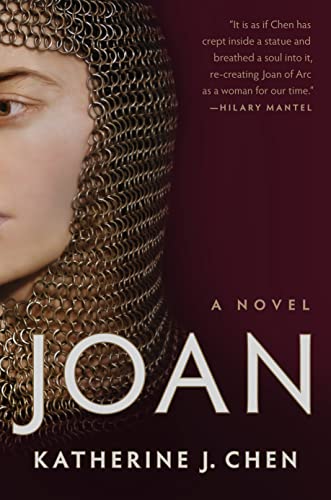
Joan by Katherine Chen

The illustration shows head of the title character in profile, wearing a coif of silver chainmail, against a maroon background.

By Sahana C.

From the very first moment of this book, I was entranced. Joan of Arc has always been a captivating figure, martyred as she was, but I didn’t know much of her other than what they taught me in Sunday School after church —  she was chosen by God to free France and end the Hundred Years’ War, and non-believers had her burned at the stake but she never let her faith waver. She was true, Joan la Pucelle, Joan the Maid, until the moment she died.  

Katherine Chen does not give us that Joan at all. In fact, the prophecies, the visions, the martyrdom that Joan is known for are machinations of the nobility in the Dauphin’s court; Joan is hale, hearty, and her spirit is unbreakable all on her own. Her relationship with her God is not that of a dedicated, unwavering believer, but that of a survivor, someone who will bargain, who will talk back, who will make wagers with her God and win. Joan is a fighter to her core, surviving an abusive father, then trauma and tragedy at the hands of the English. Then she not only survives the battlefield but navigates through French aristocracy and the world of men with no one and nothing on her side except her indomitable force of will.  

I’m reading another book right now about Chaucer’s Wife of Bath and thinking a lot about the ways that women made their own ways in the world, the ways women were forced to protect themselves and safeguard their own lives. I think we’re seeing a surge in popularity of feminist retellings of myth for that exact reason, to humanize the female characters we’ve heard about before but always from a man’s perspective – always fitting into a specific trope or box. What Katherine Chen has managed to do with Joan is just that — Joan, the saint, the martyr, is made human in this book. And no matter how close to God the rest of the world thinks she is, because of the work done to turn her into a mascot, Joan was a girl. Strong enough to best the British, brave enough to lead the French, and fierce enough to ensure she would be remembered.

Joan is available in print, e-book, and e-audiobook. If you’re looking for an inspiring, incredibly written read about a historical character that we’ve heard a lot about, but never necessarily in a way that makes her human, relatable, knowable – then Joan is for you. 

Sahana is an Instructor and Research Specialist at the Savage Branch. They enjoy adding books to their “want to read” list despite having a mountain of books waiting for them already.

A Little Love for Urban Lit

The book cover photographs show a woman in partial profile, leaning over her bare shoulder, above a cityscape at night, with twinkling lights and a hazy red sunset in the background.

by Angie E.

Also known as street lit or hood lit, urban fiction focuses on the gritty realities of life in the inner cities and the raw, unfiltered experiences that expose the highs and lows, the triumphs and tragedies of urban life. It emerged in the late twentieth century as a genre centered in urban communities, primarily among African American authors. While being vibrant and compelling, it often finds itself grappling with preconceived notions and stereotypes. Despite its popularity and cultural significance, it is often dismissed or misunderstood.

From street hustlers and drug dealers to determined mothers and aspiring entrepreneurs, these individuals often navigate morally ambiguous situations, creating a nuanced narrative. By examining the motivations and inner conflicts of its characters, urban fiction humanizes those who may be pigeon-holed, encouraging readers to challenge their preconceptions and recognize the complexity within individuals.

The genre has played an important role in amplifying underrepresented voices and providing a space for authors to share their lived experiences. Featuring protagonists from diverse backgrounds and communities, urban fiction offers a refreshing departure from other contemporary literature, which has historically been dominated by a narrow set of perspectives.

If you’re looking to get started with reading urban fiction, you can’t go wrong with Tracy Brown (whom, I was saddened to hear, recently passed away).

Her books, which are set in Staten Island and focus on women who triumph despite adversity, have been Essence magazine and USA Today bestsellers. Tracy Brown also started and ran a nonprofit organization known as We Are Ladies First, which serves to inform, inspire, and empower young women.

Set in the 80s and 90s, White Lines portrays authentic and multifaceted characters. Jada, the protagonist, is a beautifully flawed individual whose journey is heart-wrenching. Brown writes her with depth and vulnerability. As the narrative unfolds, we meet a diverse cast of characters, each with their unique stories and motivations. From Jada’s childhood friend Born, who walks a fine line between right and wrong, to the mysterious and captivating Cuban, whose connection to Jada sparks a whirlwind romance, these characters leave a lasting impression.

Beyond its compelling characters, White Lines delves into thought-provoking themes that confront societal issues head-on. The exploration of the drug epidemic, the impact on families, and the consequences of choices made under desperate circumstances are handled with a delicate balance of compassion and realism. Brown’s narrative serves as a powerful reminder of the human toll that addiction can exact on individuals and their communities.

While the story deals with heavy subject matter, Brown’s storytelling keeps the pacing engaging throughout. The plot twists and turns, keeping readers on their toes, and the emotional depth of the narrative never falters.

Angie is an Instructor & Research Specialist at Central Branch and is a co-facilitator for Reads of Acceptance, HCLS’ first LGBTQ-focused book club. Her ideal day is reading in her cozy armchair, with her cat Henry next to her.

Be part of HCLS’ Summer Reading Adventures.

The Early Days of Television

The cover of When Women Invented Television is set against a yellow background with black and white pictures of Betty White, Hazel Scott, Irna Phillips, and Gertrude Berg.

By Peter N.

Yoo-hoo, Mrs. Goldberg! 

In Jennifer Keishin Armstrong’s When Women Invented Television, she talks about the early days of television and the rise of popular TV programs that defined what America was watching for decades to come. But four women in particular were TV powerhouses who foretold the coming of modern-day television personalities we have come to love, such as Ellen DeGeneres or Oprah, and sitcoms such as The Golden Girls. They were among the first of television’s pioneers during the transition from radio to television as America’s most popular medium of entertainment. 

There once was a woman by the name of Gertrude Berg, and what a woman she was! She was the creator behind the much-lauded radio show The Rise of the Goldbergs, an NBC radio show showcasing the lives of a Jewish family living in the Bronx and cared for by their matriarch Molly Goldberg, as played by Gertrude Berg. After years of high ratings on radio, she worked tirelessly to bring her show to a fledgling new medium called television, and when she succeeded there was no stopping her. At its peak, The Goldbergs was dominating the airwaves, and much if not all the credit goes to the woman behind it all, Molly Goldberg…I mean, Gertrude Berg. She was creator, writer, and star behind her hit show and nothing could stop her. What she accomplished in a time when patriarchal views and traditional family values were taking hold is nothing short of astounding.  

It’s Time to Say Hello Again… 

Ah, Betty White. What can I say about Betty White that hasn’t already been said countless times? Sadly, at the time of this post, she will have gone to that great TV studio in the sky to join her husband, Allen Ludden. Betty White was made for television. From her early days on KLAC hosting with Al Jarvis for 5.5 hours a day, to being the main lead on the sitcom Life with Elizabeth, to hosting her own talk show, The Betty White Show, she was unstoppable. Her infectious smile, dimples, and radiant personality won over countless millions, and at one time she was having to turn jobs away because she was working too much! She loved to work and one could say that show business was the love of her life. She fought against prejudice against her during the early days of television as a single woman not trying to settle down and have a family. Through it all, she would continue to be invited into the living rooms of her legion of fans for years to come.  

The Guiding Light 

Irna Phillips was the guiding (pun intended) force behind The Guiding Light, the longest running soap opera on television. Its earliest incarnation was as a popular radio show, which is why Irna Phillips knew that it would be just what television needed. Working tirelessly for years along with raising two adopted children and doing the best that she could possibly do, she finally was able to bring her show to TV. She was not only a single mother of two children when it was believed families should have a mother and a father, but with the success of The Guiding Light, she became the figurative mother of the soap opera genre in a time when that genre was still very much maligned. Her works have reverberated through daytime television through her own shows as well as mentoring Agnes Dixon, creator of many other long-running soap operas. This was a woman who tried not to let anything stand in the way of bringing her creation to life. 

The Hazel Scott Show 

In a time when racial segregation was still running rampant, Hazel Scott managed to become one of the first African American people to headline their own show on network television. Already an accomplished musician and used to playing to large crowds, she brought her talent to The Hazel Scott Show to great reception and ratings. Her television career was cut short when she was targeted by the infamous publication Red Channels, which listed suspected communists in various areas of entertainment. She bravely defended herself, but she could not recover her TV career. However, she persevered and returned to her roots as a musician and touring. Her TV stint was brief but powerful all the same.  

These four women were astonishing and it was a pleasure to read about their accomplishments, their legacy, and the effects they’ve had on popular culture. One can only imagine what they could have done had they not been impeded by the politics of their era.

When Women Invented Television is available in print and as an eBook and an eAudiobook from Libby.  

Peter is an Instructor and Research Specialist at the Miller Branch and is continually grateful to Lucille Ball and Desi Arnaz not only for pioneering methods of television production that enabled generations to experience the brilliance of early television, but also for taking the chance on a small sci-fi show that still endures 50 years later.  

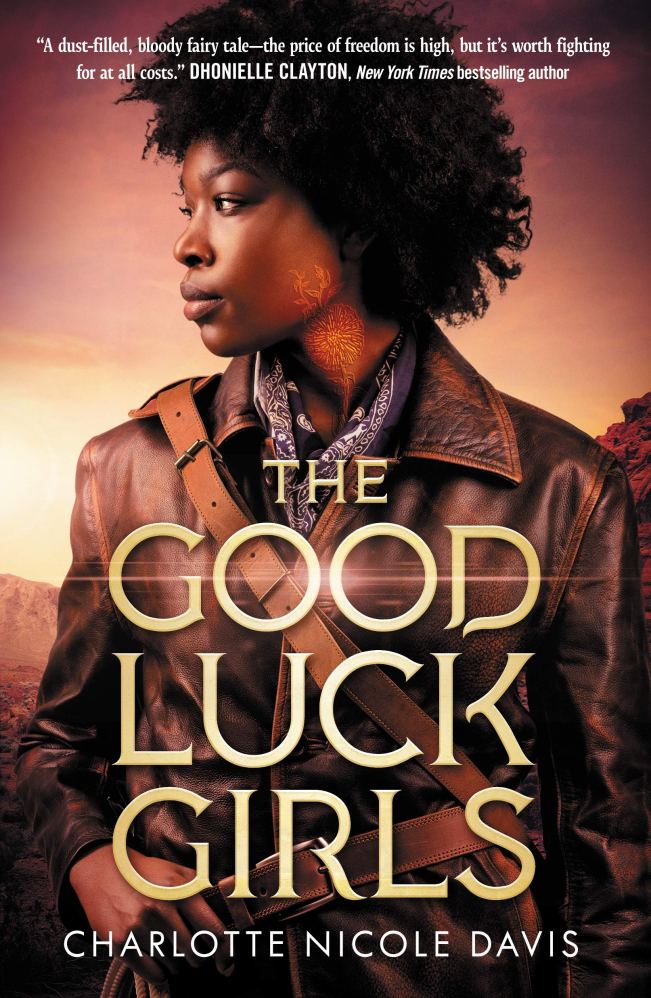
The Good Luck Girls by Charlotte Nicole Davis

The cover shows a young Black woman looking to the left, dressed for the trail in a leather coat and a strap for a bag across her chest. She has a floral tattoo on the side of her neck.

by Kristen B.

The Good Luck Girls is a flat-out running adventure of escape and escapade, complete with undead monsters, bank robberies, and a secret rebel base. In the country of Arketta, good luck girls are sold to “welcome houses” as children, basically into indentured servitude where they start as housemaids until they graduate to serving customers more personally. The male patrons of welcome houses are called “brags” by the women who work there. This book is filled with so many smart details that make it real.

Favors are the magical tattoos that mark the girls’ throats and match their names, which cannot be removed or covered without dire consequences. The girls in this story will do almost anything to remove those favors and be free of the welcome house. Meet the girls:

Aster, the protector, is the big sister and the one who has gumption to say, “time to go, girls.”

Violet, the favorite and the survivor who may have regrets, also has the secret information to get everyone to safety.

Tansy, the herbalist and medic, is the heart of the bunch who keeps everyone pointed in the same direction.

Mallow, the fighter, meets life with fists up but learns the hard way how to pick which fights are worth having.

Clementine, the catalyst and Aster’s younger sister, has a catastrophic Lucky Night and becomes the reason this group of girls flees into the wilderness. She wants so much more from life than a Welcome House can offer.

After Clementine’s debut ends with a very important brag dead in her bed, the girls figure out how make an escape, heading North to freedom. The girls follow clues from the story of Lady Ghost passed from good luck girl to good luck girl, but no one knows the truth – although Violet claims to have special knowledge. They discover a male guide to take them through rough country, who brings all the usual complications. He is also looking for redemption and a new life, and makes the difference for surviving in the deep wilderness. The group learns to rely on and (maybe even a little bit) love each other like family.

There are some solid themes underlying all the fun, including gender and race issues. These young women demonstrate their abilities to do what’s necessary to achieve their goals, despite physical and emotional trauma. As they reclaim their identities and their independence, questions arise about who the law protects and serves and when a little rebellion is a good thing. Honestly, I rooted for the girls during their first bank heist … even if it’s a crime.

I gulped this book down over one weekend. I can’t wait to see what these girls do next as I am pretty sure that each one of them is entirely capable of making her own good luck.

The Good Luck Girls is available in traditional print, book on CD, and as an eBook.

Kristen B. is a devoted bookworm lucky enough to work as the graphic designer for HCLS. She likes to read, stitch, and take walks in the park.

Norfolk, Archaeology, and a Touch of Crime: The Ruth Galloway Mysteries

The cover of The Crossing Places shows a black owl with yellow eyes atop a black perch, against a turquoise background.

By Julie F.

London native and Brighton resident Elly Griffiths has had a phenomenal (and very busy!) career since publishing the first Ruth Galloway mystery, The Crossing Places, in 2009. The author of three children’s books, the Stephens and Mephisto historical mystery series, and the Harbinder Kaur mystery series, she is the winner of the 2020 Edgar Allan Poe award for Best Novel for the first Kaur mystery, The Stranger Diaries. She also won the Dagger in the Library award from the Crime Writers’ Association, which is a prize for a body of work by a crime writer that users of libraries particularly admire.

Although all of her work is acclaimed, the Ruth Galloway novels are especially beloved by her devoted readers. Ruth is a forensic archaeologist who teaches at the University of North Norfolk, where her best friend, Shona, is married to the head of Ruth’s department. Over the span of thirteen novels, Ruth nurtures a passion for the work that consumes her academic life but also spills over into her personal life and a second job as an adjunct to the North Norfolk police constabulary. Like many police officers, DCI Harry Nelson is haunted by the one case he couldn’t solve – that of a missing five-year-old, who was taken from her parents’ home ten years ago and is now missing, presumed dead. When bones are discovered on the beach near Ruth’s home, DCI Nelson calls on Ruth to help the police date and identify them. An Iron Age discovery ensues, another child goes missing, and Ruth finds herself pulled into a case that has ramifications both past and present. The Crossing Places is an excellent start to a series where following the quirky, familiar characters we learn to love doesn’t overshadow the intensity of the mystery; Griffiths is skilled at developing both character AND plot.

Through the course of the series, Ruth has chilling adventure after adventure: she carbon-dates bones found on the site of an old children’s home in the process of being demolished; she attends the scene of the discovery of a downed World War II plane which presumably has the skeleton of the pilot intact; and a jaunt to Italy at the request of a fellow archaeologist needing help with his own most recent discovery results in a kind of working holiday. As the books progress, her relationship with DCI Nelson, both professional and personal, goes through a series of ups and downs that has the reader rooting for both the cranky but decent old-school DCI and the strong-willed, independent archaeologist.

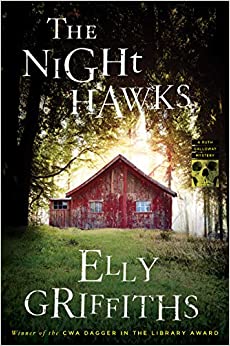
The cover of The Night Hawks shows a backlit red house with a triangular roof, with dark trees above and green grass in the foreground.

The most recent novel, The Night Hawks, has the titular group of treasure hunters combing the beach in North Norfolk when they come across a body – and a cache of Bronze Age weapons, which is of real interest to Ruth and a new university colleague. DCI Nelson speculates that the body, which is not from antiquity, might be that of an asylum seeker who washed overboard in a storm, but the death is quickly linked to a murder-suicide at a nearby house, Black Dog Farm. The name ties into local legend about a huge, spectral black dog who haunts the area, adding an element of the paranormal to an already complicated mystery.

Both The Crossing Places and The Night Hawks are worthy additions to a compelling series, but I can recommend every entry – I’ve read and enjoyed every story involving DCI Nelson and his team, and Ruth and her colleagues, for well over a decade now. I’m still looking forward to more suspenseful mysteries from them – in a recent interview, Elly Griffiths said she is hard at work on the fourteenth Ruth Galloway novel, The Locked Room. Fans of Louise Penny, Ann Cleeves, and other writers of character-driven police procedurals will find much to enjoy and admire about this suspenseful series.

Julie is an instructor and research specialist at HCLS Miller Branch who finds her work as co-editor of Chapter Chats very rewarding. She loves gardening, birds, books, all kinds of music, and the great outdoors.

The Night Watchman by Louise Erdrich

The book cover has the title and author's name in white lettering against a background of stripes of varying widths in shades of blue, purple, and green.

By Piyali C.

Books have their unique ways of clearing the lenses through which we view life. They tell us stories of people whose struggles may not have found a prominent place in history books. Louise Erdrich’s The Night Watchman revolves around one such nugget of history.

The central theme of the book is the fight against Native dispossession from North Dakota by the Turtle Mountain Chippewa tribe, which was led by Louise Erdrich’s grandfather, Patrick Gourneau. The protagonist of the book, Thomas Wazhashk, is created in the image of Gourneau, who fought against a 1953 bill introduced by Senator Arthur V. Watkins to terminate the rights of the Chippewa tribe over their land in the reservation; Gorneau led a delegation of tribal Council Members in protest. Like Gourneau, Thomas is a night watchman in a jewel-bearing plant, the first factory located near the Turtle Mountain Reservation in rural North Dakota. Thomas spends every night guarding the factory, and during the day he meets with tribal elders as they plan to take their protest against Watkins’ bill to Washington, DC. Their efforts, however, require money the tribe does not have.

Thomas’s wife, Rose, not only supports him in this endeavor, but also is a pillar of the Chippewa community whose identity Thomas and other tribal leaders seek to preserve. Many women from the tribe find employment in the factory, putting beads on jewelry. One of these women is Patrice Paranteau, who happens to be Thomas’s niece. Patrice is a fierce, strong, independent young woman who single-handedly takes care of her mother and brother and continues to look for her sister, Vera, who went to the Cities and never came back. Unlike the other women in the tribe, Patrice is not looking for a husband and children, although there are a few men who desire her affection. She wants self-sufficiency and financial independence so she can stop her alcoholic and abusive father from hurting her mother and brother. Patrice saves every penny to fund her search for her big sister, Vera. Rumor has it that Vera has been seen in the city with a baby. Patrice never gives up hope that Vera will return, even after she finds despairing signs of Vera’s death when she goes to Minneapolis to look for her. During her search for Vera, Patrice encounters extreme violence and ugliness that endangers her own life, yet she remains undaunted. Louise Erdrich does not shy away from showing her readers the violence and exploitation that Native American women are subjected to in real life.

Although the novel revolves around the Chippewa tribe’s determination to stop the Termination Bill, Erdrich weaves a beautiful and sensitive story of love, loss, and hope, with characters who will remain in the heart of readers long after they finish the book. Each character created with utmost love and minutiae is a beautiful composite of the whole Turtle Mountain Chippewa tribe, who band together to fight for their existence and identity under Thomas’s leadership. For me, the character of Patrice Paranteau embodies the indomitable spirit, the fierceness, the mysticism, and the harmony of Native American tribes.

This was a spectacular book, incorporating the struggles of the Turtle Mountain Chippewa tribe as well as their resilience and sensitivity. I am still wandering in the pages of the book where the line between reality and paranormal sometimes became blurry, but it made perfect sense in the world that Erdrich creates for her predecessors. My library-sponsored book club, Global Reads, discussed this book a few weeks ago. We all agreed this was a beautiful story, an important story, a story that needs to be read to learn how people with little power rose up to the all-powerful government to demand what was rightfully theirs.

The Night Watchman by Louise Erdrich is available in print as well as in ebook and eaudiobook format from Libby/OverDrive. Louise Erdrich is the author of seventeen novels and the owner of Birchbark Books, an independent bookstore in Minneapolis.

Piyali is an instructor and research specialist at the Miller Branch of HCLS, where she co-facilitates both Global Reads and Strictly Historical Fiction.